Overview

Tedi — from ontoTerminology EDItor — is the environment in which most of the laboratory's published datasets were authored. It exists to solve a specific problem: terminologies and ontologies are usually built as separate artefacts that drift apart, and multilingual terminologies in particular tend to be organised around one language with the others treated as translations.

Tedi separates the two layers. You build a formal ontology of concepts, and you build a list of terms in each language independently. The languages are then related to one another through the ontology rather than through each other, so no language is privileged as the source.

The approach rests on symbolic artificial intelligence rather than statistics, and follows the principles of ISO 1087 and ISO 704, the international standards for terminology work.

Getting Tedi

Tedi is a desktop application, distributed by the University of Crete free of charge for academic teaching and research. Download it from the download page; installing it constitutes acceptance of the licence.

A slide deck introducing the software is published as Introduction to Tedi (June 2024, PDF), and there is a video series.

The conceptual dimension

Concepts are defined by their characteristics, distinguished as essential or descriptive. Tedi applies Aristotelian principles as epistemological guidelines: logical properties are checked while the ontology is being built rather than validated afterwards.

The practical consequence is that the editor constrains what you can do. When you specify a new generic concept, only the concepts that remain logically valid are offered. An inconsistent hierarchy is difficult to construct in the first place, which is a different design philosophy from an editor that accepts anything and reports errors later.

The linguistic dimension

Each language gets its own term list, built in the Term-List editor and defined without reference to the others. Because every term denotes a concept in the shared ontology, the lists relate to each other automatically.

This gives precise definitions of two ideas that are usually left loose. Two terms in different languages are terminological equivalents when they denote the same concept; two terms in the same language are terminological synonyms under the same condition. Tedi computes both rather than asking you to assert them.

For the lab's own material this matters: the datasets carry terms in English, Ancient Greek, Modern Greek and, in one case, Mandarin Chinese, with no single language acting as the pivot.

The editors

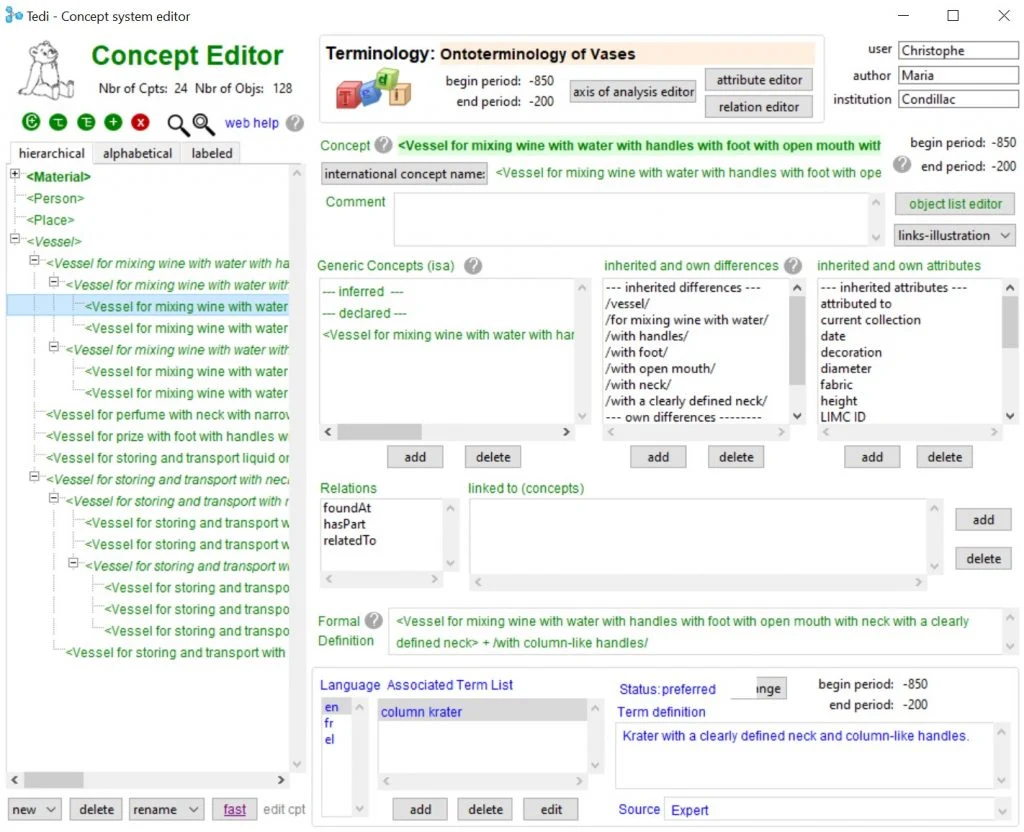
Tedi is organised as four editors over the same model.

  • Concept editor — the formal ontology: concepts, their characteristics and their hierarchy.
  • Term editor — the term lists, one per language, with definitions.
  • Object editor — individuals instantiating the concepts. This is where a dataset gets its populated content: the 439 individuals in Göbekli Tepe, the 3,230 in Philosophers.
  • Proper Name editor — names denoting objects, handled separately from terms denoting concepts.

The distinction in the last two is the one newcomers find unfamiliar: a term denotes a concept, a proper name denotes an object. Sappho is a proper name; “lyric poet” is a term.

Export formats

An ontoterminology can be exported for several downstream uses:

RDF/OWLFor Protégé, and for loading into the SPARQL endpoint and the OTV viewer
HTMLe-Dictionaries and object collections for reading
SKOSThesaurus and vocabulary exchange
TBXThe terminology exchange standard
OntoLexLexicon-ontology interchange
CSVFor CmapTools concept mapping
.otbTedi's own working format

The RDF/OWL export is the route from Tedi to everything else on this site: it is what gets deposited on Zenodo and loaded into the triplestore.

Licence & citation

Tedi was specified, designed and implemented by Prof. Christophe Roche. The University of Crete distributes it on a non-exclusive basis for the duration of the TALOS-AI4SSH project (HORIZON-WIDERA-2022-TALENTS-01, 2023–2028). The licence is between the University as licensor and you as licensee, and covers every version of the software. Installing Tedi constitutes acceptance of it.

Tedi is not open source. Unlike the laboratory's other software, which is Apache 2.0, Tedi is distributed under a personal academic licence. The summary below is for orientation only — the licence page is the authoritative text, and you should read it before installing.

What you may do

  • Use Tedi for academic teaching and research, free of charge.
  • Use it within your own organisation, on the number of machines or user seats your licence type covers.
  • Make copies for archival or backup purposes.

What you may not do

  • Transfer the licence. It is personal and non-transferable, and may not be sub-licensed or outsourced to a third party.
  • Redistribute the software in any form or by any means — that includes publishing, transmitting or reproducing it.
  • Use it commercially, or make it available inside any service or product offered to a third party, without written consent from Cincom.
  • Modify or reverse engineer it: no adapting, decompiling, disassembling, decrypting or extracting.

Warranty and liability

Tedi is licensed “as is”. The University and the author disclaim all warranties, express or implied, and do not warrant that the software is free of bugs or that it will run correctly in every combination of hardware and software. If it proves defective, the cost of any repair or replacement falls to you. Liability for indirect, incidental or consequential damages — lost data, lost profits, loss of goodwill — is excluded, and cumulative liability is capped at the licence fees paid.

Tedi was not developed for use in nuclear, aviation, mass transit, medical or other inherently dangerous applications, and is not licensed for them.

Platform sublicence

Tedi is written in Smalltalk and runs on Cincom VisualWorks, so it also carries a Cincom Smalltalk licence agreement (number QS-529). Under it, Tedi is licensed rather than sold: no title, and no implied grant of any copyright, patent, trade secret or trademark passes to you. You receive a non-exclusive licence to the object code only.

Export control

Tedi may fall under UN, EU, US and UK export control and sanctions regulations. By using it you confirm you are not located in a sanctioned country or named on a sanctioned-parties list, and you take responsibility for obtaining any export or import authorisation your own use requires. It may not be used in connection with nuclear, chemical or biological weapons, or with unsafeguarded nuclear activity.

Citation

Citing the software is a condition of the licence, not a courtesy: every use of Tedi or its accompanying materials, documentation included, must be cited.

Roche, C. (2025). Tedi (version VERSION-NUMBER).
Distributed freely by the University of Crete, Greece.

Licensing enquiries

Questions about the licence or about commercial use go to the author, whose contact details are on the licence page. For anything else about Tedi at the laboratory, see contact.